1TVPAC Team
TEMECULA— Two consecutive months of Temecula Valley Unified School District board meetings reinforced a troubling reality: while district staff continue to carry the weight of educating students and managing operations, the elected board of trustees remains mired in infighting, political posturing, and missed opportunities to address urgent student needs.
In November, trustees once again abdicated meaningful agenda-setting to district staff. The only substantive items—secondary grading practices in science, future grading practices in secondary physical education, and an update on the Science of Reading in early grades—were allotted a combined total of seven minutes. Even the legally required review of CAASPP data received just 15 minutes.
In December, the board technically fulfilled its legal obligations by reviewing and approving the First Interim Financial Report, but the meeting included no discussion of educational priorities whatsoever. Instead, the night devolved into procedural chaos centered on the annual board reorganization, culminating in an abrupt adjournment over security concerns after a heated argument in the parking lot.
Across both months, the pattern remained unchanged: trustees spent far more time baiting, quarreling, and debating procedure than governing.
Meanwhile, teachers again appeared before the board asking for help with escalating classroom violence and behavior issues. Once again, those pleas went unanswered.
Perhaps most alarming, for the second consecutive month, Trustees Anderson, Komrosky, and Wiersma refused even to agendize the continuation of a free, parent-approved substance abuse education and treatment program—a program that:
Has been 100% effective for two years
Is free to students and families
Fulfills a legal requirement
Has support from district staff, community members, and even some of the trustees’ own political supporters
Their unfounded concern that the program might “indoctrinate” students stands as one of the most irrational and harmful examples of board mismanagement in the past three years.
The only consistently thoughtful and student-centered comments across both meetings came not from elected trustees, but from Student Board Member Melissa Chai.
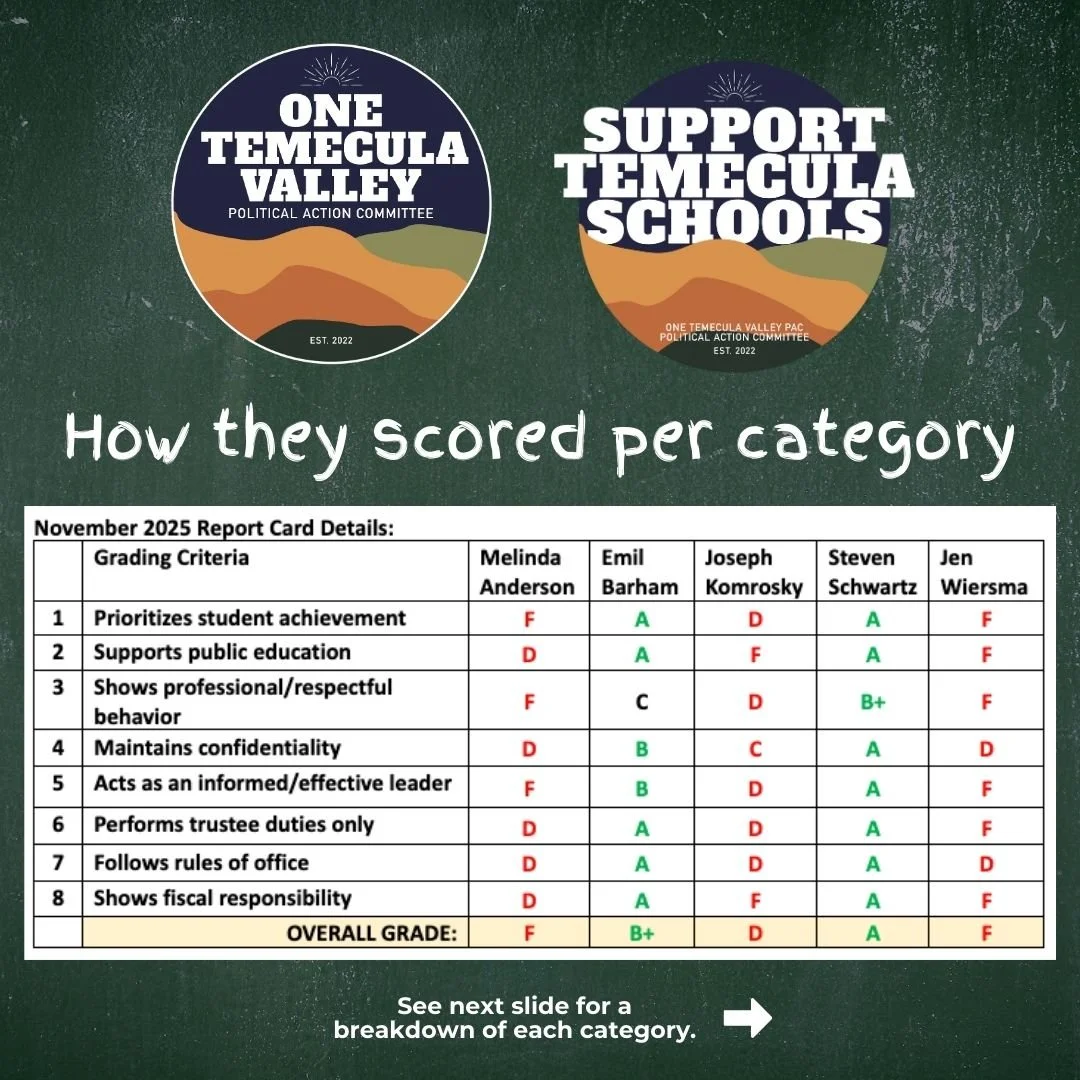
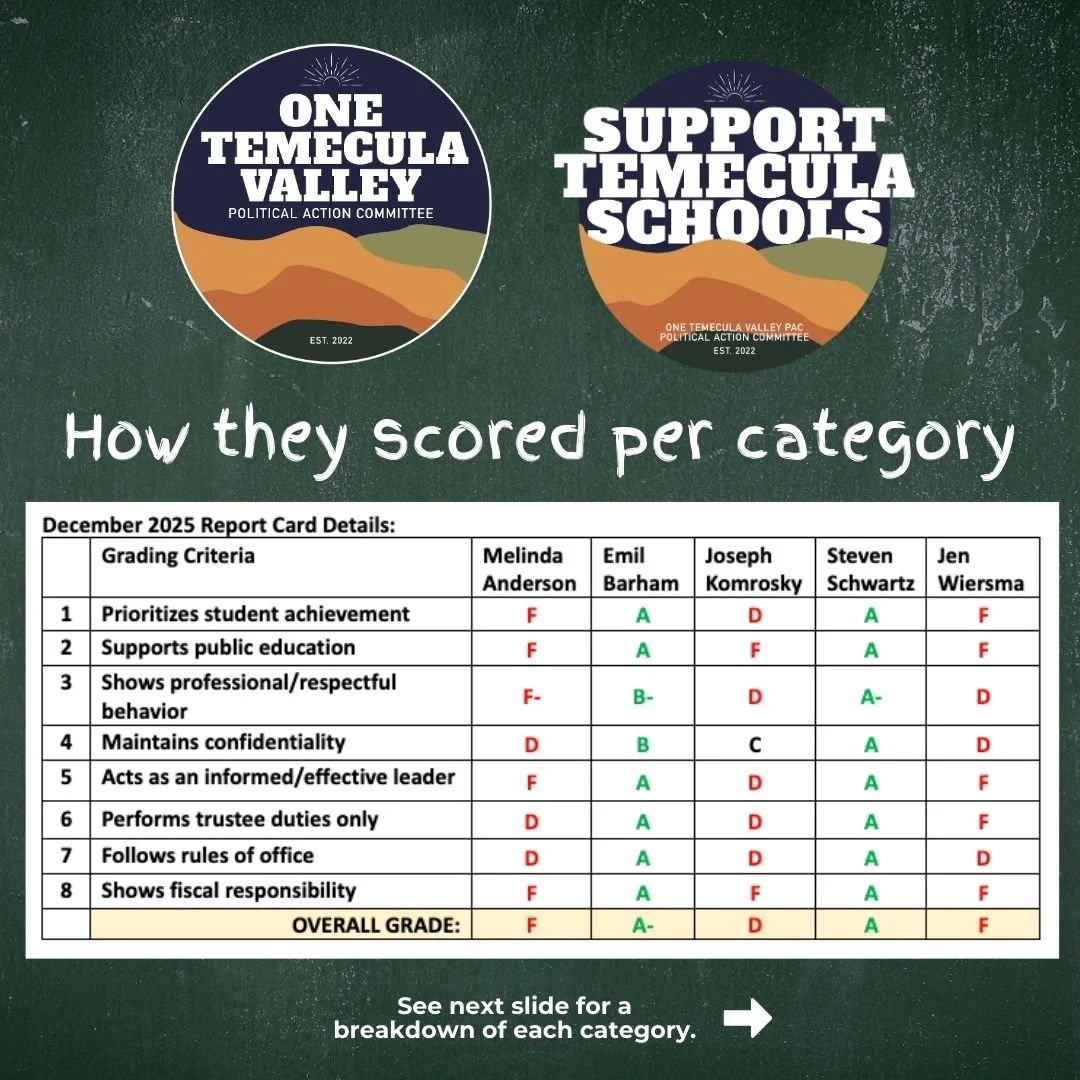
Against this backdrop, the November/December Trustee Report Card reflects not just stagnation—but escalation.
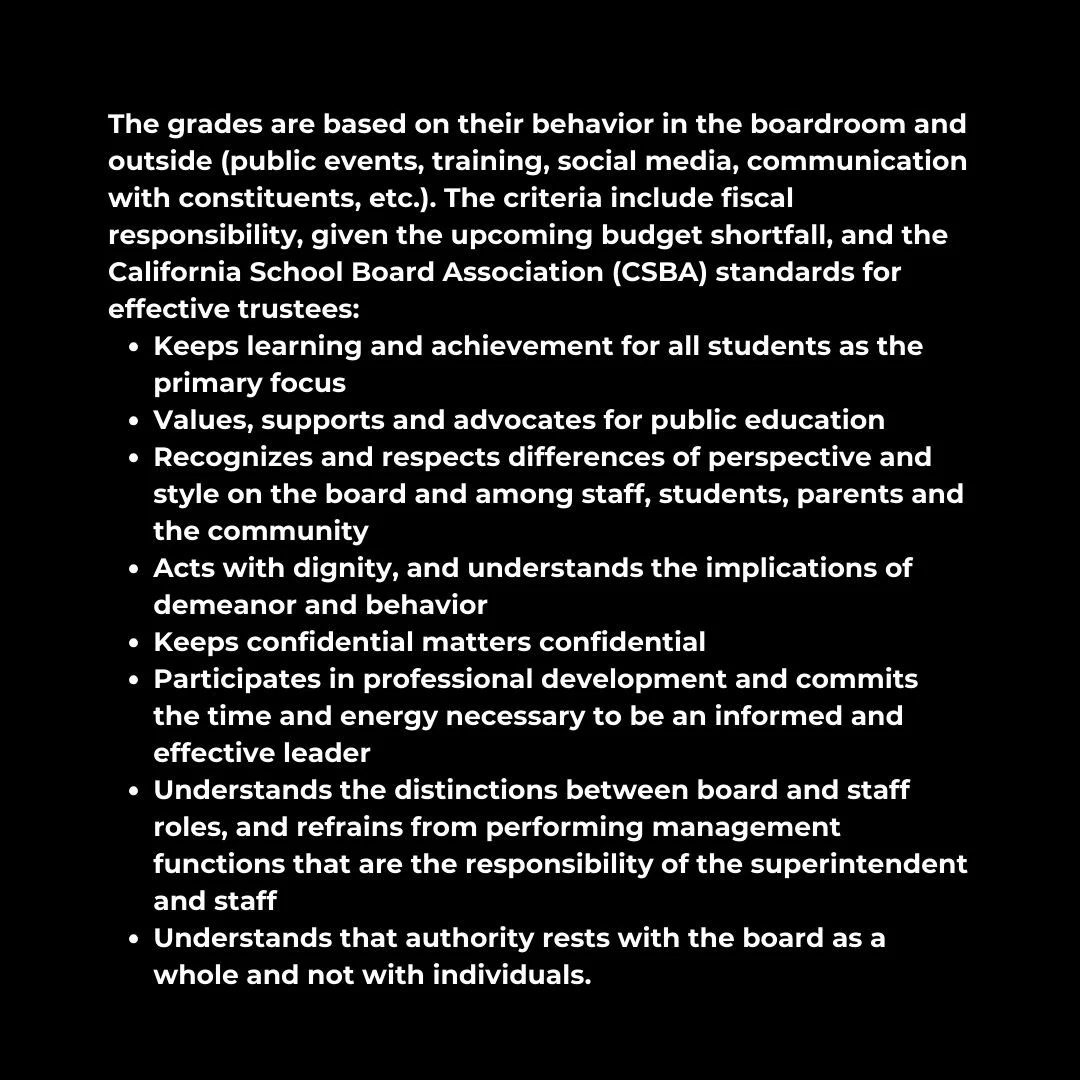
Trustee Report Cards
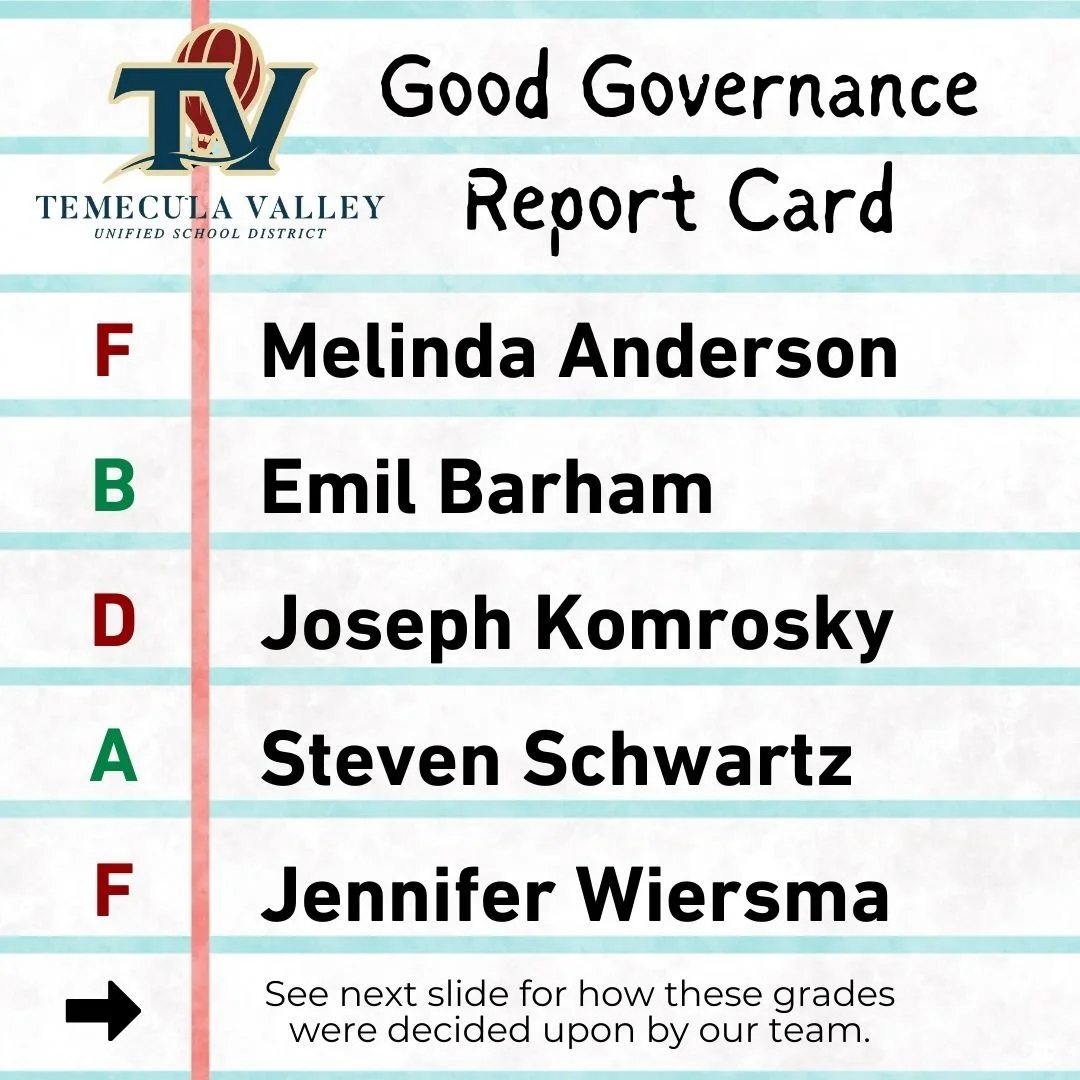
Melinda Anderson: F
Local elected officials generally fall into three categories: those who help their district, those who do little but cause no harm, and those who actively hurt progress. For much of 2025, Board President Melinda Anderson occupied the middle category. In the second half of the year, she moved decisively into the third.
Anderson does not visit schools, meet with teachers, speak with campus staff, or serve meaningfully on committees. Her role appears limited to attending most board meetings—though even that is inconsistent. Despite personally selecting December’s meeting date in November, she still stepped out early for another commitment, while finding time to discuss a non–school board event she attended.
In meetings, Anderson increasingly introduced politically motivated agenda items, presided in a heavy-handed manner, and engaged in constant bickering that derailed real business. Her leadership failures culminated in December’s reorganization meeting:
She publicly acknowledged that Steve Schwartz was the best choice for Board President
She initially voted against Dr. Joseph Komrosky
Then reversed course, nominated Komrosky herself, and voted with Komrosky and Wiersma to elect him 3–2
This decision—despite clear public support for Schwartz—demonstrated unequivocally that Anderson has no interest in improving board function or district direction. December’s meeting ended without a Clerk elected and left January’s agenda burdened with unfinished business.
Anderson’s priorities do not include TVUSD students, staff, or stability.
Emil Barham: B / B+
In November, Trustee Emil Barham showed signs of drifting off course. His participation in board bickering and on-dais theatrics undercut what has otherwise been a record of thoughtful, education-focused engagement. His ego occasionally got the better of his mission.
In December, however, Barham demonstrated a noticeable course correction. Prior to Anderson’s arrival, he ran the meeting capably, treated speakers respectfully, and maintained professionalism under pressure. He continues to ask the most substantive questions about curriculum, student outcomes, and district operations.
Barham remains committed to students and the district. A continued focus on steadiness—and avoidance of unnecessary conflict—will allow him to regain the momentum he previously built.
Joseph Komrosky: D
Dr. Joseph Komrosky has learned to waste less time than he once did, adopting a posture of watching and waiting—likely influenced by his desire to reclaim the board presidency and position himself for re-election in 2026.
But his priorities remain unchanged. Komrosky continues to view district issues through the lens of national culture wars rather than local educational needs. He stated directly to students in the room that he does not represent them, a remark that visibly offended those present and suggests a fundamental misunderstanding of his role after more than two years in office.
Despite repeated claims of expertise in electromagnetic fields (EMF), Komrosky has provided no credible evidence to support those assertions—and such expertise is irrelevant to the district’s universally agreed-upon goal of reducing cell phone use for effective learning.
His election as Board President in December raises serious concerns about how much further board dysfunction may escalate in 2026.
Steve Schwartz: A
Trustee Steve Schwartz remains the board’s most prepared, professional, and student-focused member. He consistently listens to staff, engages with teachers, and anchors discussions in educational outcomes rather than ideology or ego.
Despite overwhelming public support—and even Anderson’s own acknowledgment—Schwartz was passed over for Board President. In that role, he could have curtailed much of the board’s non-educational dysfunction and redirected focus toward student achievement.
Even without the title, Schwartz continues to serve as the board’s stabilizing force. Many in the community hope future elections will provide him with colleagues equally committed to responsible governance.
Jennifer Wiersma: F
Trustee Jennifer Wiersma remains completely ineffective. She rarely pays attention unless the discussion involves her name or her agenda item. She consistently fails to report on subcommittee work, arrives unaware of initiatives already underway, and offers “new opportunities” that duplicate existing district efforts.
Her focus appears to be squarely on her 2026 re-election campaign; at the November meeting she finally brought something student related to the agenda, however it was redundant and unnecessary. As of now, she has no substantive accomplishments to point to after three years in office, and nearly every initiative she has championed has faced legal rebuke.
Her social media conduct, personal grievances, and performative politics continue to erode her credibility and distract from the real work of improving student safety and achievement.
Final thoughts
The combined November and December report card reveals a board drifting further from its purpose. Strong district staff continue to move TVUSD forward despite a governing body consumed by politics, procedure fights, and personal agendas.
Teachers are asking for help. Families are asking for support. Students deserve leadership focused on learning—not chaos.
With three board seats up for election in November 2026, the question is no longer whether change is needed, but whether trustees—or voters—will finally demand it.